
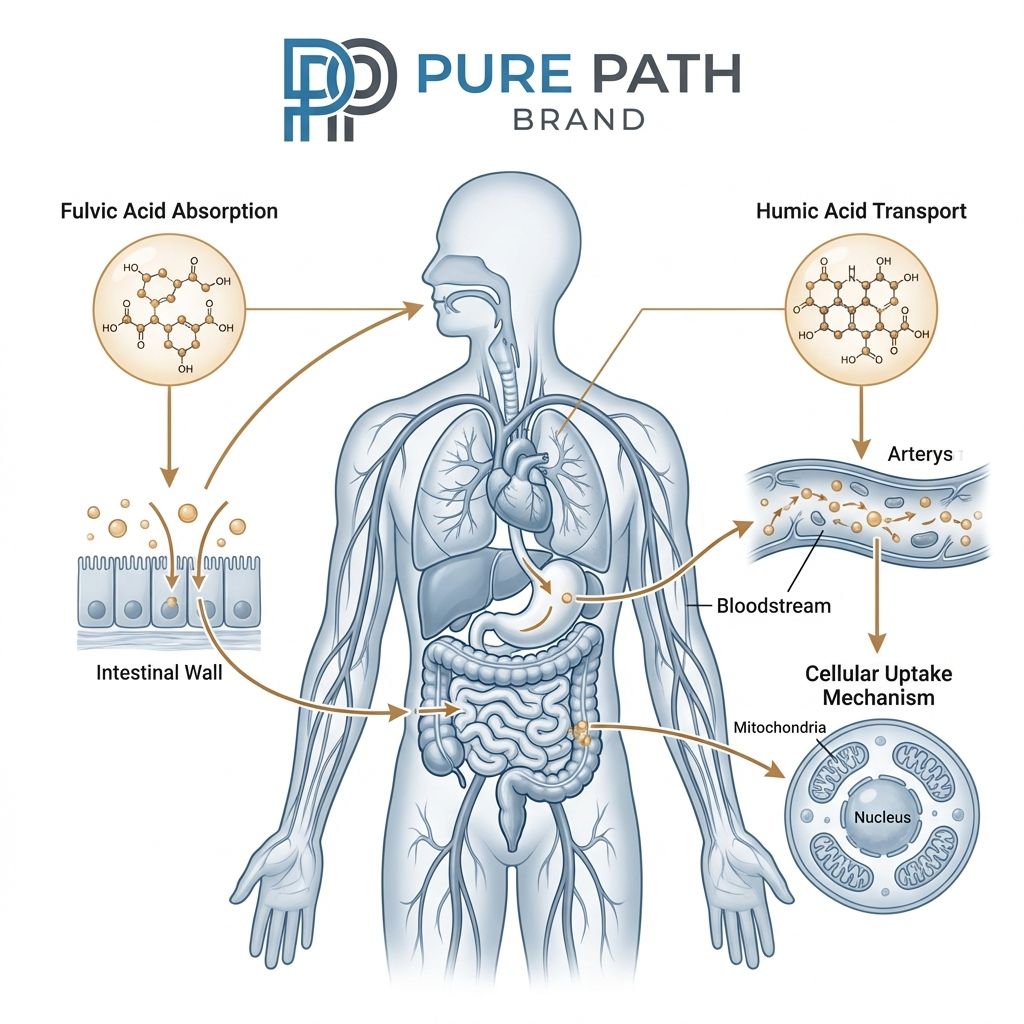
Fulvic acid is a low-molecular-weight organic acid formed as plant matter humifies over thousands to millions of years. Of all the humic substances, it is the smallest, the most oxygen-rich, and the only fraction that stays fully dissolved at every pH the human digestive tract can throw at it. That last property is why it matters: a molecule that survives stomach acid and intestinal alkalinity can keep doing its job the whole way down.
The Transport-Molecule Perspective
Most supplement conversations obsess over dosage — how many milligrams of magnesium, zinc, or peptide you swallowed. The question almost nobody asks is how much of it reached a cell that could use it. Nutrients don't diffuse into cells for free. Membranes are selective, and many minerals cross poorly on their own.
Fulvic acid functions as a chelator and carrier. Its dense array of carboxyl (-COOH) and phenolic hydroxyl (-OH) groups grabs mineral ions and holds them in a bioavailable, organic complex. Because the fulvic-mineral complex is small and amphiphilic, it interacts readily with cell membranes — research on fulvic acids describes enhanced membrane permeability and mineral transport as their signature behavior.
What the Functional Groups Actually Do
Think of the carboxyl and hydroxyl groups as the "hands" of the molecule:
- Chelation: the hands grip mineral ions (iron, magnesium, zinc, trace elements), preventing them from clumping into unabsorbable salts in the gut.
- pH adaptation: the same groups donate or accept protons as the environment changes, which is why fulvic stays soluble from stomach (pH ~2) to intestine (pH ~8).
- Electron shuttling: fulvic acids are redox-active — they can donate and accept electrons, which is the basis for the antioxidant activity reported in the literature.
This is also why extraction method is not a detail. Aggressive heat or harsh chemistry can strip or denature these functional groups. The molecule may still assay as "fulvic acid" on a label while behaving like inert brown powder. Cold-water extraction exists to keep the hands attached. (Full explainer: Why Cold Extraction Matters.)
Where It Comes From
Fulvic acid does not come from fresh compost. Commercial-grade material is extracted from humate deposits — ancient beds of plant matter that humified over geologic time. Pure Path sources from Utah, USA deposits, which allows a domestic, auditable chain from raw humate to finished pouch, with third-party Certificates of Analysis on every batch.
Fulvic vs Humic vs Shilajit — the 30-Second Map
- Fulvic acid: smallest fraction, soluble at all pH, nutrient delivery inward.
- Humic acid: larger fraction, binds toxins and heavy metals, escort outward. See What Is Humic Acid?
- Shilajit: crude mountain resin that contains some fulvic (typically 15–20%) plus geological tars and, in many tested products, measurable heavy metals. See the full comparison.
How People Use It
The standard protocol is simple: 250–500mg of purified fulvic powder in water, once daily, on an empty stomach, ideally 20–30 minutes before food or the rest of a supplement stack. It is positioned under a stack, not instead of one — the delivery layer that makes the rest of the spend count. Track hydration, mental clarity, and recovery over 2–4 weeks.
These statements have not been evaluated by the FDA. This article is educational and not medical advice — consult your physician before starting any supplement.